
MBA for Teachers: Build a Career Beyond the Classroom
This post is sponsored by Polymath Institute, the nonprofit behind Pivot MBA™.
You lead a room full of people every day. You plan months ahead, adjust on the fly, calm worried parents, report on progress to your principal, and somehow still remember who needs a pencil.
Then you open a job posting. It asks for “stakeholder management,” “project planning” and “business acumen.” And a quiet voice says: that's not me.
It is you. You've just been describing it in a different language.
If you're thinking about leaving teaching for a new career, here's the good news: the gap was never skill. It's the credential and the business vocabulary that help a hiring manager see what you already do. That's where the right MBA for teachers can help, and it's why we're excited to introduce you to Pivot MBA™ from Polymath Institute.
Key takeaways
An MBA for teachers works best when it turns skills you already use, like leading, planning and managing stakeholders, into business language and a credential employers recognize.
Teaching skills map directly to roles in operations, project management, healthcare administration and more.
Pivot MBA™ is built for educators changing careers: small live online cohorts of about 20 educators, with the first cohort starting January 2027.
Pivot MBA has no big upfront tuition bill. Students pay a deposit and monthly payments, and a future employer partner pays half of tuition in exchange for a work commitment after graduation.
What transferable teaching skills do employers want outside the classroom?
Employers outside of education want the skills teachers use every day: leading groups, planning long-term projects, managing many stakeholders, adjusting based on data and communicating clearly under pressure. The difference is vocabulary and context. Teachers call it lesson planning and parent conferences. Companies call it project management and stakeholder communication.
Here's how a few everyday teaching tasks translate:
| What you do in the classroom | What a business calls it | Where it shows up |
|---|---|---|
| Planning a unit backward from standards | Project planning and scoping | Operations, project management |
| Leading a class of 25+ students | People leadership | Team lead, program manager |
| Parent conferences, IEP meetings, admin updates | Stakeholder management | Partnerships, healthcare administration, account management |
| Tracking assessment data and reteaching | Data-informed decision making | Operations, edtech, program evaluation |
| Differentiating for every learner | Customer-centered design | Edtech, customer success, product |
| Building curriculum with a grade-level team | Cross-functional collaboration | Almost every team role |
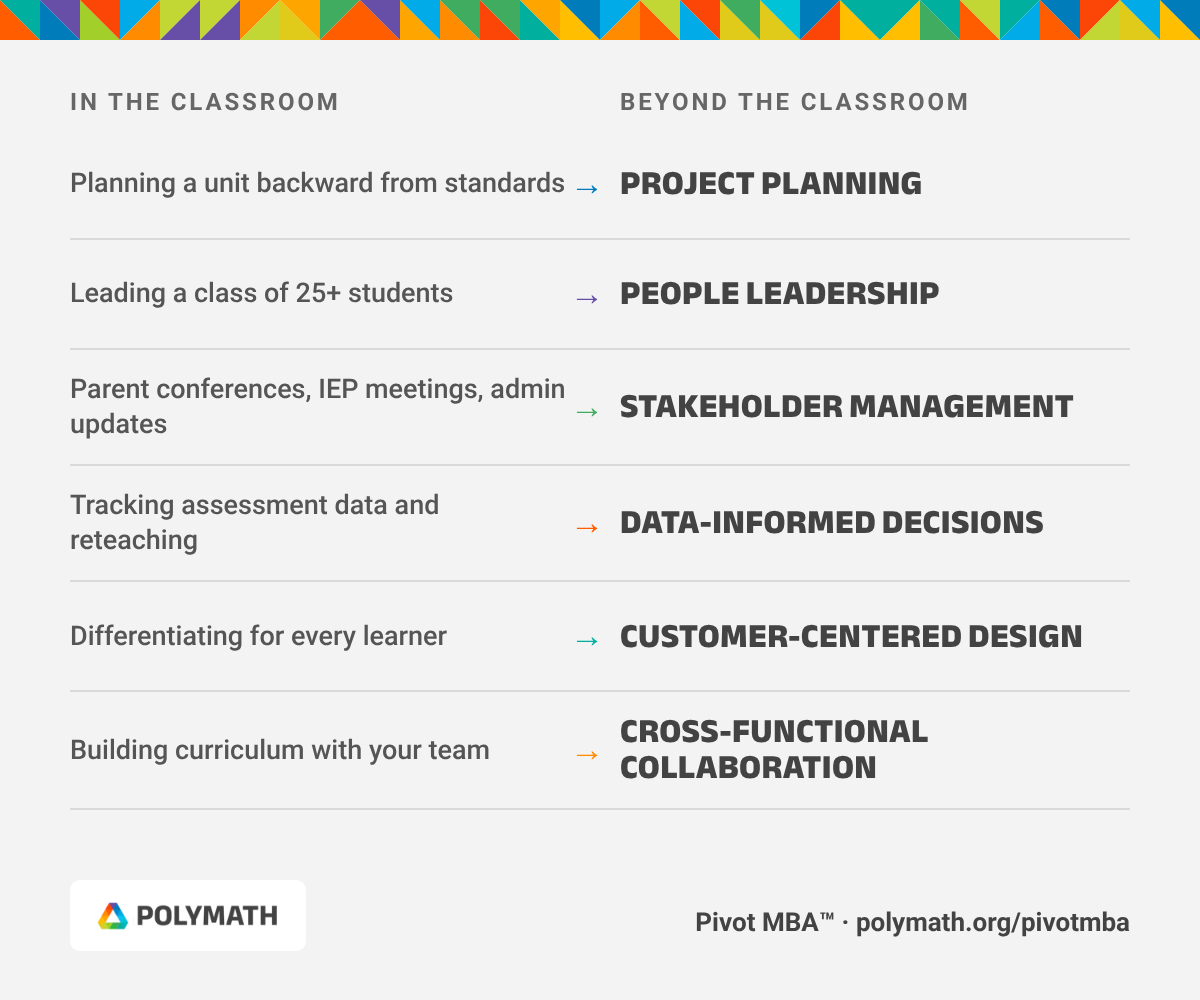
Read that left column again. That's not “just teaching.” That's a résumé.
Why do teachers get stuck when they try to change careers?
Most teachers who want to leave teaching get stuck for two reasons: they don't have a business credential, and they don't yet have the business language to describe their experience. Neither one is a skill gap. Both are translation gaps, and both can be closed.
If you've ever thought “I'd basically be starting over,” we hear you. You're not starting over. You're building on a powerful foundation. The work now is helping the rest of the world see it.
Is an MBA for teachers worth it?
An MBA can be worth it for teachers who want to move into business, healthcare, edtech or operations roles and need a recognized credential to prove their skills. It's most worth it when the program is designed around your experience, fits around a teaching schedule and doesn't leave you with a big upfront tuition bill.
Which MBA is best for teachers? What to look for
Built for career changers. The program should treat your classroom years as an asset, not a gap.
A real peer cohort. Learning alongside people making the same move keeps you going on the hard weeks.
An online format for working teachers. Live online sessions mean no commute, and you can explore your options before you leave the classroom.
A payment model you can plan around. Look closely at upfront costs, monthly costs and debt at graduation.
A bridge to an actual job. Employer partnerships matter more than a diploma on its own.
Meet Pivot MBA™: an MBA designed for educators changing careers
Pivot MBA™ is an MBA designed specifically for educators who are ready for what's next. It takes the classroom skills you already use, like leadership, planning and managing stakeholders, and turns them into a business credential.
Small, live cohorts of educators
Pivot MBA™ students learn in small, live cohorts of about 20 educators who meet online over Zoom. Your cohort stays together through the program, so you learn alongside peers who are making the same professional pivot you are.
Affordable by design
There's no big upfront tuition bill. You start with a deposit, then make monthly payments. Half of the tuition is paid by your future employer partner, in exchange for a work commitment after you graduate.
What the program includes
A fully remote program that runs 20 months
An accredited MBA, offered in partnership with Defiance College (accredited by the Higher Learning Commission)
The PMI Project Management Professional (PMP) exam, with the exam fee covered
A full-time, paid apprenticeship of two to four months with an employer partner
Built by someone who has made big pivots himself
Pivot MBA™ is built by Polymath Institute, a nonprofit founded by Dan Futrell. Dan is an Army infantry veteran, a former school board member, the former CEO of the Pat Tillman Foundation and a graduate of Harvard Kennedy School (MPP).
The first cohort starts January 2027
Seats in the first cohort are limited. If you're a teacher, instructional coach or school leader who has been thinking about this for a while, now is a good time to take a closer look.
How to start your educator career pivot
An educator career pivot starts with naming what you already do well, then choosing a direction and building the proof. Here's a simple path:
List the skills you use every week. Use the table above as a starting point.
Pick a direction. Operations, project management, healthcare administration and edtech are common fits. Not sure yet? Our free career quiz can help you see which path fits you best.
Practice the language. Rewrite one résumé line. “Planned and delivered a 36-week curriculum for 120 students” becomes “Planned and delivered a year-long program for 120 stakeholders, on schedule.”
Get the credential that opens the door. An MBA built for educators, like Pivot MBA™, turns that experience into proof employers recognize.
Talk to people who have made the leap. For more ideas on where teachers land, read our guide to alternative careers for teachers.
Frequently asked questions
Can teachers get an MBA without a business background?
Yes. Some MBA programs are designed specifically for educators. Pivot MBA™ is built for K–12 teachers, instructional coaches and school leaders, and it treats classroom experience as business experience. Check Polymath's FAQ for current admissions requirements.
What jobs can teachers get with an MBA outside the classroom?
Teachers with an MBA often move into operations, project management, healthcare administration, program management and edtech roles. These careers use the planning, leadership and stakeholder skills teachers build every day, described in business language.
Can teachers earn an MBA online while working full time?
Yes. Many MBA programs for working teachers are online. Pivot MBA™ is fully remote, with live sessions on Zoom, so there's no commute or move. It also includes a full-time, paid apprenticeship of two to four months, so ask Polymath at an info session how the schedule fits around teaching.
Should teachers get an MBA or a master's in educational leadership?
It depends on where you want to go. A master's in educational leadership usually prepares you for roles inside schools, like principal or district leader. An MBA prepares you for roles outside the classroom, like operations, project management, healthcare administration and edtech. If you're ready to pivot beyond the classroom, an MBA built for educators is the closer fit.
How long does Pivot MBA take?
Pivot MBA is a 20-month, fully remote program. Students learn in a live cohort of about 20 educators who meet online over Zoom, and the cohort stays together through the program.
How much does Pivot MBA cost?
Pivot MBA starts with a deposit, followed by monthly payments, so there's no big upfront tuition bill. Polymath lists the student share as $475 per month, which is half of tuition. An employer partner pays the other half.
What is the Pivot MBA work commitment?
Because an employer partner pays half of your tuition, you agree to work for that employer after you graduate. Polymath describes this as a two-year commitment to the employer partner that invested in you.
When does the first Pivot MBA cohort start?
The first Pivot MBA cohort starts in January 2027, and seats are limited. Polymath runs 45-minute info sessions with its founder, and you can register even if you can't attend live to get the recording.
Your skills are worth more than you've been told
You already lead, plan, adapt and bring people together. You don't need to become someone new. You need the language and the credential that show the world what you've been doing all along.
If Pivot MBA™ sounds like the next step, start with a short info session. You'll hear how the debt-free model and apprenticeship work, and whether it's the right fit for you.
